


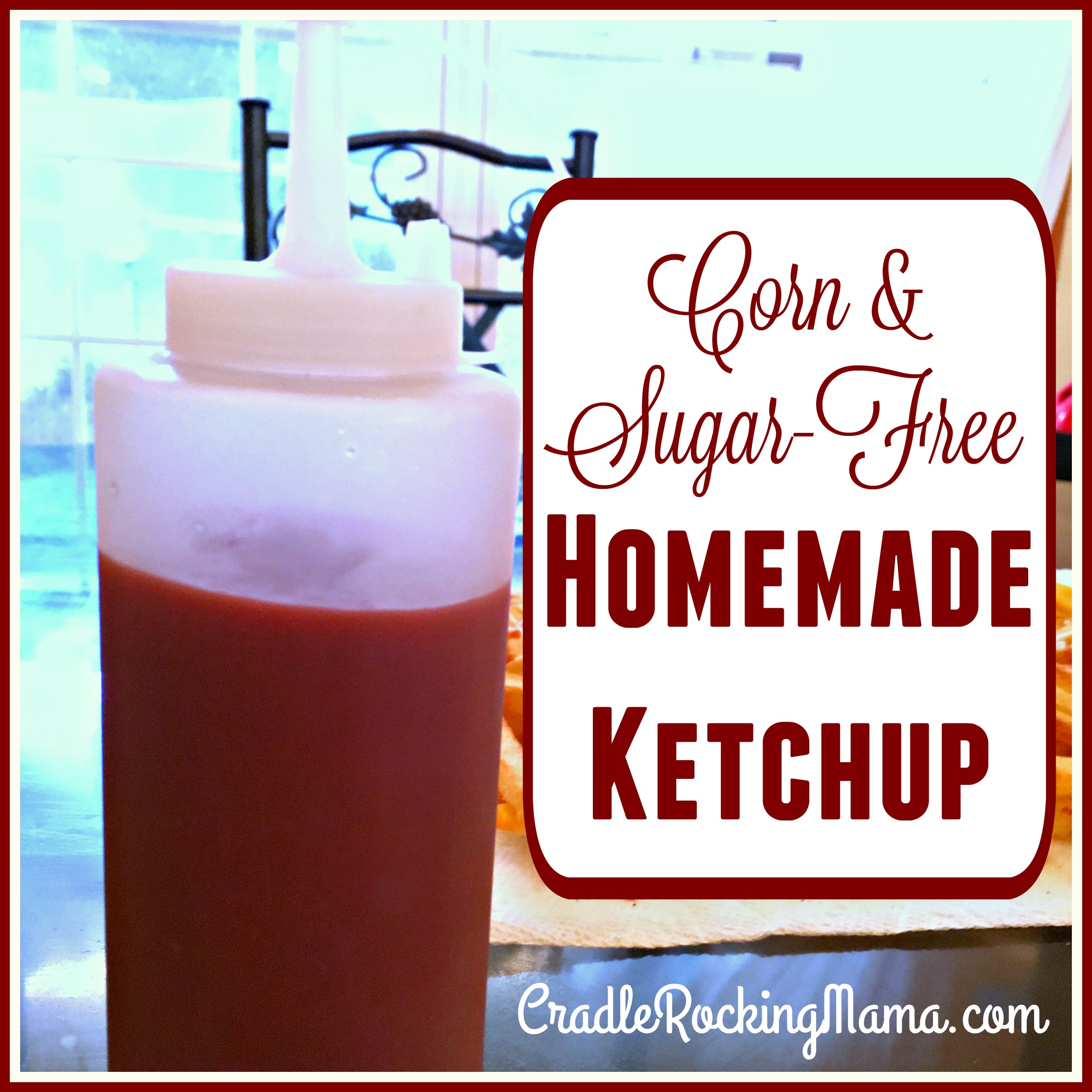
 A while back I posted my homemade ketchup recipe. It’s delicious, it’s perfect, it’s wonderful…and we can no longer use it!
When I first started making it, I only made it for Jed. I knew that vinegar was made from corn, but that was okay. This wasn’t for Zac. Later I learned that dextrose is also made out of corn, but again, this wasn’t for Zac, and Jed didn’t have a problem with corn.
Ahem.
We learned earlier this year that Jed does, in fact, have a problem with corn. Corn is no longer allowed in our home in any shape or form. Furthermore, I have decided sugar has no place in our home except on very rare, very special occasions, and in incredibly small doses.
Jed was devastated. No ketchup? Oh, the agony! The betrayal! Whatever shall a ketchup loving kiddo do??
Nag Mom, of course! Nag her until her ears want to bleed, and she finally gets around to tweaking the recipe to be safe.
I’ve made some interesting substitutions, but I assure you, this is still an excellent ketchup. It no longer tastes exactly like store-bought ketchup, but in many ways, that’s a plus.
Now it tastes like gourmet ketchup.
(We’re gettin’ fancy up in here, y’all.)

Oh, one little thing. The substitution for dextrose I made requires another recipe of mine: homemade stevia extract. If you haven’t already, go make some. I’ll wait.
*
*
*
Just kidding! That recipe is no longer an option for many of you due to the fact that the growing season is coming to a close and stevia plants aren’t really around any more. (Although, if you have some stevia plants, not only can you still make this, but you can actually dig that plant up, transplant it to a container, and keep it alive through the winter in your house! We did that last year, and it was awesome!)
If you have some homemade stevia extract laying around, you’re golden. If you don’t, you can still make this; you’ll just need to choose a substitution that works for you. (And next spring? Plant some stevia to make your own extract! It’s divine!)
- Option #1 – powdered stevia; choose which one you like and experiment to see how much you want to add.
- Option #2 – sugar, but in INCREDIBLY reduced amounts!
The other change I made was to the vinegar. I switched that out for lemon juice.
As far as lemon juice goes, fresh is best! Even at my health food co-op, where the goal is organic/real food, there is citric acid in the bottled lemon juice. Citric acid=CORN, so go buy a ton of lemons, squeeze those puppies, and freeze the extra in ice cube trays. Then you can have ketchup year round.
Unfortunately, this version is no longer the same price as store-bought ketchup. The lemons make it a bit pricier. Boo.
Fortunately, Zac can now have this recipe! (He won’t eat it, because he apparently doesn’t like ketchup, but he could if he wanted to! Sigh…)
I’ve recently gotten into lacto-fermenting, and I understand you can make ketchup that way, so I imagine that one day I’ll be presenting a third ketchup recipe. Well, I suppose one can never have too many methods of preparing something as awesome as ketchup, right?
You’ll notice the quantities of lemon juice and water are much higher than in the previous recipe. Without all that sugar adding volume, it needed a lot more liquid to make it work. Don’t worry; it isn’t a misprint!
For best results, let the flavors marry and meld in the fridge for a day before using. It’s good straightaway, but the lemon is a lot stronger at first. It mellows and becomes almost undetectable after a night hanging out on the door of your fridge.
So here it is: how to make a homemade ketchup that is completely corn free and sugar free!
- one 6 ounce can of tomato paste
- ½ c. fresh squeezed lemon juice (3-4 lemons)
- ½ c filtered or spring water
- 1 tsp. salt
- ⅛ tsp. ground celery
- pinch of ground cloves
- 2-3 tsp. homemade stevia extract OR 2-3 scoops of powdered stevia OR 2-3 T. sugar
- Roll your lemons on the counter, cut in half, and squeeze ½ c. of juice.
- Put tomato paste, lemon juice, water, salt, ground celery, and cloves into a saucepan and whisk together until smooth. (If using sugar as a sweetener, add it now as well.)
- Heat on medium heat until just boiling; immediately reduce heat and simmer for 20 more minutes, stirring frequently.
- Remove from heat and let cool on the counter for 10 minutes.
- Add the stevia extract and whisk together until well blended.
- Let cool completely before adding to a bottle or jar.
- Store in a covered container in the fridge.
- For best results, let the flavors meld for a day in the fridge before eating.
- Enjoy your healthier, delicious ketchup!
Happy Dipping!
What’s your favorite unusual ketchup flavor?
One Response to Corn & Sugar-Free Homemade Ketchup